
 Login »
Project X
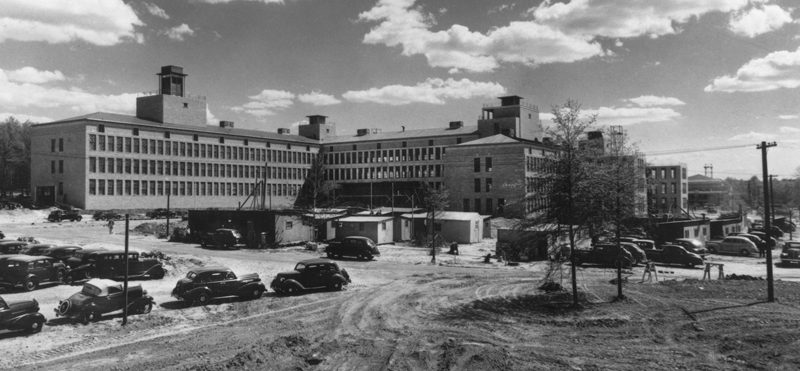
In 1940 Bell Telephone Laboratories, the US counterpart to the GPO Research Station at Dollis Hill, started work on developing a secure transatlantic telephone system. This research was known as Project X.
There were two teams, both supervised by Alva B. Clark, one working on the encryption itself and the other on the practical aspects of design and construction.
In the 1930s two American engineers from Bell Labs, Eugene Peterson and Homer Dudley, had developed a system called a voice encoder, or ‘vocoder’, which they had demonstrated at the 1939 World's Fair in New York, and their work now formed the basis for Project X.
Peterson and Dudley's system, which they called the Voder (Voice Operating Demonstrator), was the first attempt to electronically synthesise human speech by imitating the effects of the vocal tract.
The Voder
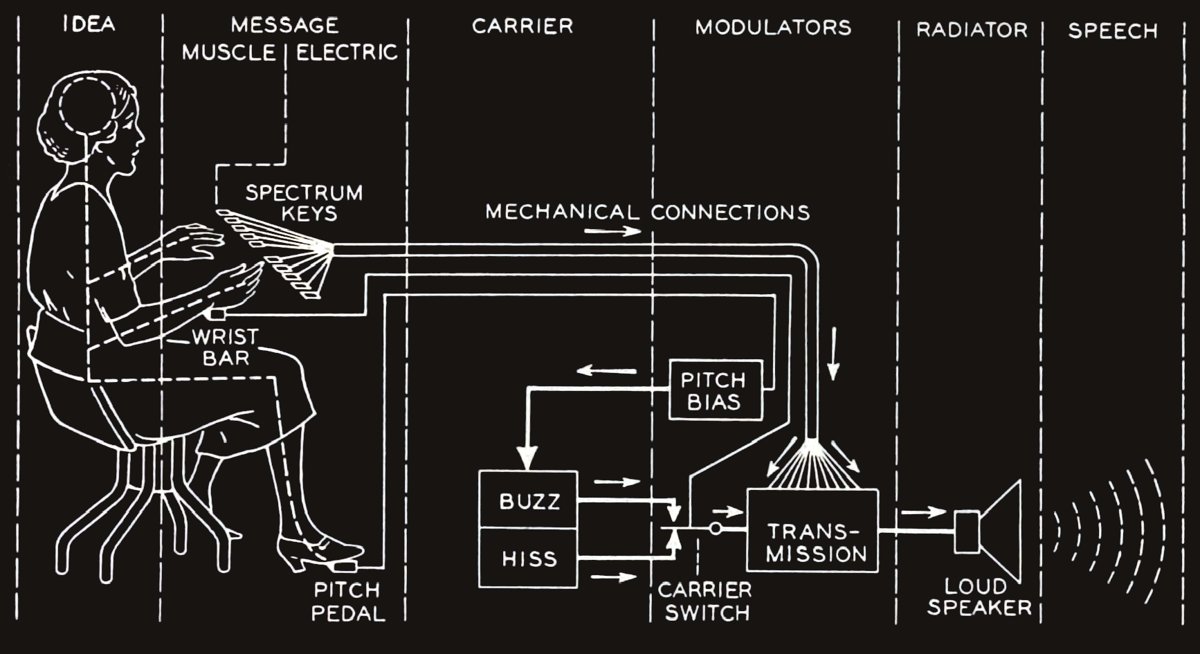
Using a foot pedal to control pitch, a wrist bar to select one of two basic sounds (buzz or hiss), and a set of keys to select one of ten band pass filters, an operator could speak through a loudspeaker using just their hands and feet. The system took some practice to operate, but after a while a trained operator could use it to produce recognisable speech.
The work done to break human speech down into its most basic components, and reduce it into ten specific audio spectrum bands, would form the key to Project X and reduce the amount of information that needed to be encrypted.
In addition, the ability of the Voder to take the input values from the keys, wrist bar and foot pedal and convert them into an electrical sound signal representing speech was crucial to reconstructing the decrypted data back into speech. The key to Project X was using the Voder technology to recreate the analogue audio signal at the receiving end.
Turning speech into numbers
Project X worked by taking the audio signal from the telephone line and sampling it many times per second.
The samples were then split into one of ten channels, or frequency bands, from 150Hz to 2950Hz, depending on the frequency of the voice at that point. The amplitude of each channel was then measured and its value encoded. This was the first use of the principle of Pulse Code Modulation (PCM), which had been invented by Alec Reeves at Standard Telephones in London in 1937. PCM is what is used today for all digital sound transmission, from phone calls to music. It works by approximating, or ‘quantising’, the amplitude or strength of a signal at a specific point in time to a set of thresholds; the threshold value can then be transmitted as a digital number.
This resulted in ten digital values to be transmitted for each sample.
An additional signal was produced to indicate if the sound was ‘voiced’ (e.g. a, e, o, z) or ‘unvoiced’ (e.g. s, f, k), analogous to the buzz and hiss in the Voder system. If it was voiced, an additional signal indicating the pitch was also produced and transmitted. If unvoiced, the receiver generated white noise in its place.
This was transmitted as two values, giving a total of twelve for each sound sample.
Sending it down the line
The resulting values were then transmitted over the phone link using frequency shift keying. This encodes the data by varying the frequency transmitted between one of (in this case six) possible frequencies, depending on the value being transmitted.
Frequency Shift Keying (FSK) involves taking a carrier signal of a fixed frequency and altering the frequency to represent a digital 1, or ‘mark’. The diagram shows the process of encoding a digital 1 and 0 using two frequencies. The carrier signal is at a fixed frequency. As a 1 is transmitted the frequency is increased, and then returned to its previous frequency for a 0, resulting in the output signal shown at the bottom.
This process took the digital encrypted data and produced an analogue sound signal that could be transmitted over the phone network, similar to how a computer modem works. The resulting buzzing sound was what gave the system the nickname Green Hornet.
When the process was reversed at the receiving end the resulting speech was intelligible, although it could be hard to recognise who was speaking.
Encrypting the call
Before the raw values could be sent using FSK, however, they needed to be encrypted. This was done by subtracting a random value from each sample. These random values formed the encryption key. How this key was stored and synchronised at both ends of the link is explained below.
At the receiving end the decrypted data was fed to circuitry derived from the Voder system, which would synthesise the speech, producing an analogue sound wave to be fed to the phone.
Project X was a symmetric key system, meaning the same key was used for both encryption and decryption. This meant the key needed to be known by both sender and receiver, and thus some method of giving the receiver the key securely needed to be devised.
The key on a record
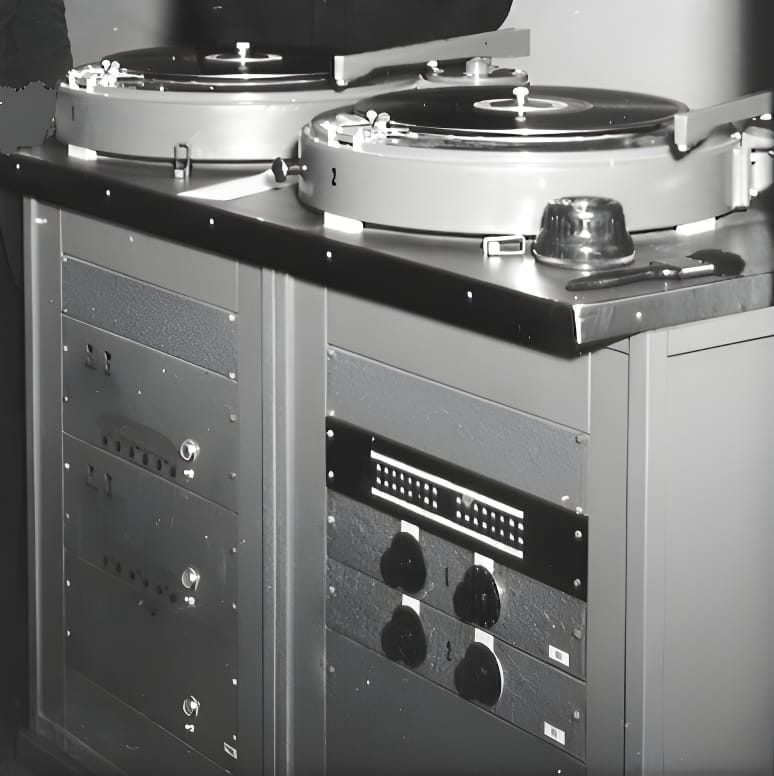
The solution was a vinyl phonograph record, which could be shipped securely to the receiving site.
Random noise values generated by mercury vapour vacuum tubes were etched onto a pair of records. The turntables at each end of the link had to be carefully synchronised, and were thus not standard record players. Each record provided a key for 12 minutes of phone call, so a second turntable was provided and a second record was queued up while the first was playing, ready to be switched in without interruption. The vinyl records were codenamed SIGGRUV (‘sig groove’).
Later, acetate-coated aluminium records were used.
They were one-time keys, meaning they were only used once and were destroyed after each call, so that they could not fall into enemy hands and be used to decode a recording of an intercepted call.