 Login »
So far, all the control logic of the switching systems we've looked at has been hard-wired. Changes to the instruction sequence or routing translations had to be done by re-wiring connections or replacing units wired differently.
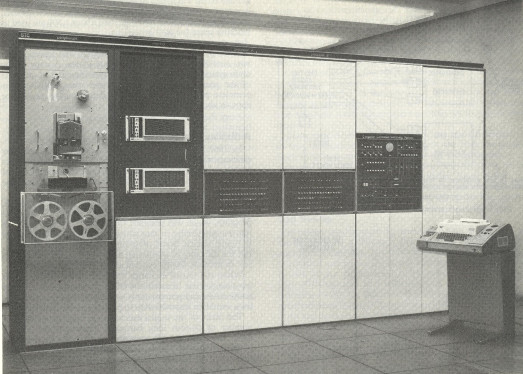
In May 1965, AT&T introduced the Electronic Switching System No. 1 (1ESS) in Succasunna, New Jersey. Designed by AT&T's Bell Labs, it was the first application of software to control telephone switching. The actual switching still used matrices of reed-relay crosspoints, as on the previous page, but unlike other reed-relay systems, the routing and control logic was done in software, making changes quick and easy. Bell Labs went on to develop a range of ESS exchanges, culminating in the 5ESS — a solid-state digital switch still in use worldwide today.
In the UK, the world's first digital exchange — a field trial called Empress, described in more detail here — did not use Stored Program Control (SPC). Despite the UK's pioneering advances in switching and transmission technology, British interest in SPC was initially somewhat lacking.
The first UK use of SPC was another prototype field trial, at Moorgate exchange, London, brought into use in March 1971 — wholly designed and built by STC. Like Empress, it was a wholly digital switch acting as a tandem switch, routing traffic between other exchanges. Traffic between Bishopsgate, Mile End & Shoreditch exchanges was routed through the prototype, gradually increasing. On seven occasions the system failed, due to software bugs and control-system component failures, but the experience gained fed directly into later systems: the TXE4 and System X.