 Login »
Talk is cheap — but it has to be billed
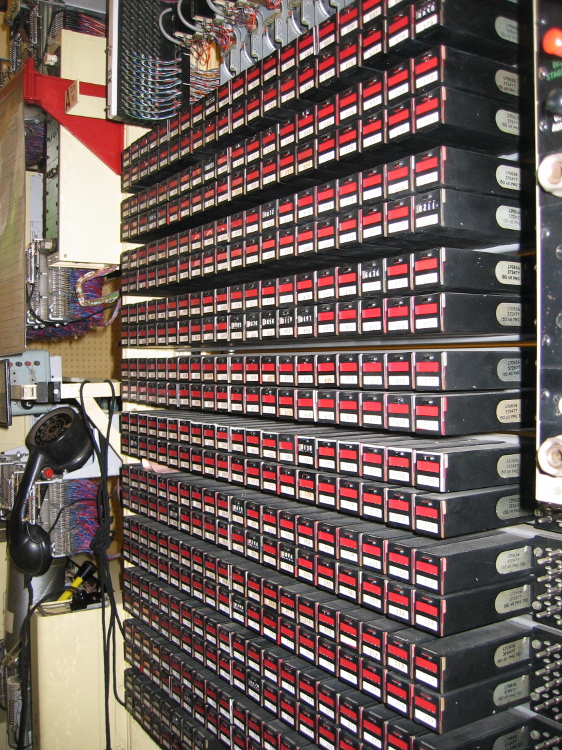
Strowger exchanges keep track of each subscriber's bill using a meter.
The exchange described here is a Non-Director Strowger exchange, as commonly used in towns. Large cities — London, Manchester, Liverpool, Birmingham, Glasgow & Edinburgh — used an additional piece of equipment called a Director, which performed routing translation on the dialled number before stepping the 2-motion selectors.
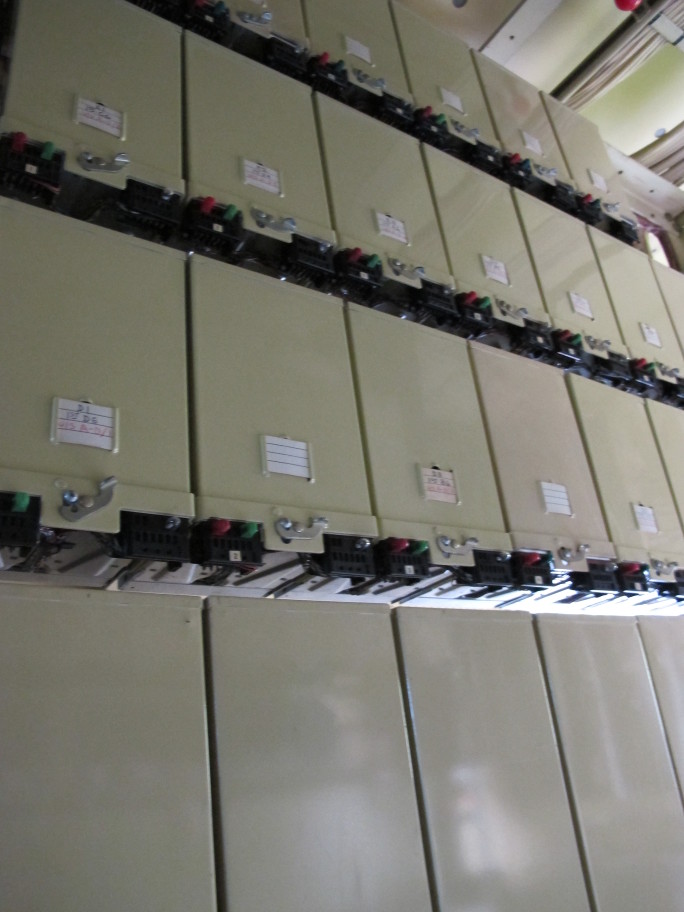
In villages, small, compact Strowger exchanges called Unit Automatic eXchanges (UAX) were used. These worked on similar principles to the Non-Director type, but were built modularly from small racks ("units") — each a small, self-contained exchange (line circuits and selectors on one rack) — that could be expanded with additional units to increase capacity easily and cheaply.
UAXs came in several types, depending on age and ultimate capacity. The first standard type was the UAX No. 5 (originally called a Rural Automatic eXchange), introduced in 1929. It was a 2-digit exchange, catering for up to 100 lines including junctions to the parent exchange. Each unit had 4 selectors and 25 lines. Automatic connection was possible only for own-exchange calls; for calls to other exchanges, you'd dial 01 to reach the operator at the parent exchange.
| Type | Subscribers per unit | Calls per unit | Design capacity | Introduced |
|---|---|---|---|---|
| UAX 1–4 | Not known | Prototypes | No information exists | Pre 1929 |
| UAX 5 | 25 | 4 | 4 units (100 subscribers / 16 calls) | 1929 |
| UAX 6–12 | No information recorded | |||
| UAX 13 | 50 | 8 | 4 units (200 subscribers / 32 calls) — some later UAX 13s served up to 800 lines | 1936 |
| UAX 14 | 100 | 10 | 8 A units (800 subscribers) | 1936 |